Law of the Great Gull
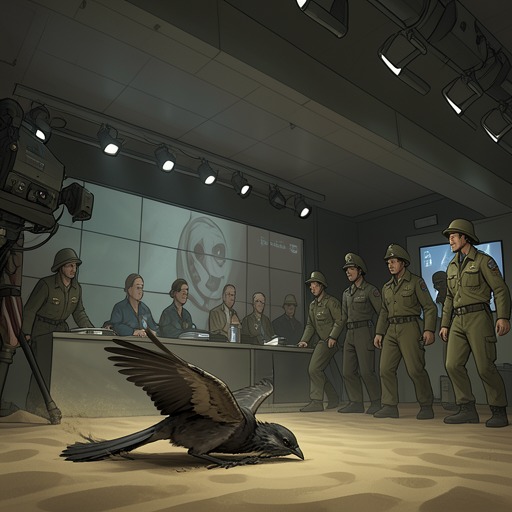
Jonathan Livingston SeagullThe Law of the Great Gull is Jonathan Livingston Seagull’s principle that a gull has the freedom to be its true self, and that the only genuine law is one that leads to freedom. Against the Flock’s prohibitions and inherited rituals, it makes flight both an innate capacity and a discipline to be discovered through practice. Its force lies in the contrast between a rule that protects custom by exclusion and a principle that asks what a gull may become.
Definition and Practice
Jonathan states the principle directly while addressing Kirk Maynard Gull, a gull who believes he cannot move his wing. Jonathan tells him that he is free to be his true self “here and now,” and identifies this as the Law of the Great Gull, “the Law that Is.” Kirk spreads his wings and rises effortlessly into the night. The exchange presents freedom not as a reward granted by the Flock, but as a capacity that can be recognized and enacted.
Jonathan’s teaching makes that principle practical rather than merely inspirational. He tells the gathered gulls that flying is right for a gull, that freedom is the nature of its being, and that whatever opposes this freedom—ritual, superstition, or limitation—must be set aside. When a voice asks whether that includes the Law of the Flock, Jonathan answers that the only true law is the one leading to freedom. His argument distinguishes law by its consequence: a rule is not just because it is old or collectively enforced; its legitimacy depends on whether it opens or closes the possibility of freedom.
Conflict with the Flock
The Law of the Great Gull stands against a social order that treats unconventional flight as an offense against tradition. Jonathan himself has been condemned by the Elder for violating the dignity and tradition of the Gull Family, and his punishment is expulsion to the Far Cliffs. Later, the Flock’s law forbids an Outcast to return, a prohibition said never to have been broken in ten thousand years. The two principles therefore collide in concrete decisions: the Flock’s rules preserve separation, while Jonathan’s teaching insists that freedom cannot be made conditional on belonging.
When Jonathan leads his students back toward the Flock’s beach, his pupils hesitate because they expect exclusion and possible hostility. The Flock reinforces its boundary by ordering its members to ignore the returning Outcasts: speaking to one makes a gull an Outcast, and even looking at one breaks the law. The response shows that the Flock’s customary law does more than prescribe conduct; it enforces isolation by making contact itself punishable. Jonathan nevertheless holds practice sessions over Council Beach, acting as though the prohibition cannot determine what the gulls may learn.
Teaching and Consequences
The return changes the terms of the conflict. The formation of eight gulls flies over Council Beach at 135 miles per hour and rolls together from level to inverted flight. The spectacle confuses the Flock’s expectation of battle, and younger gulls begin asking how the Outcasts learned to fly that way. Even while gray-feathered backs turn away from Jonathan, curiosity gathers around his lessons. The old rule remains in force, but the returning students make its limits visible: exclusion cannot prevent the Flock from seeing evidence of another possibility.
Kirk Maynard’s flight gives the principle another direct consequence. After Jonathan tells him that he is free, Kirk rises into the night and cries out that he can fly. By sunrise, nearly a thousand birds have gathered outside the circle of students to listen. When they suggest that Jonathan’s pupils must be specially gifted, Jonathan points to Fletcher Lynd Seagull, Lowell, Charles-Roland, and Judy Lee as ordinary gulls who have begun to understand what they are and to practice it. The law therefore rejects the idea that flight belongs only to exceptional or divine individuals: practice and understanding, not a special status, distinguish the students.
Significance
The Law of the Great Gull recasts flight as a measure of self-realization rather than a tool for getting from shore to food and back. Jonathan’s own devotion to flight began in resistance to the Flock’s assumption that eating mattered more than flying; his later teaching extends that resistance into a general claim about freedom. The principle connects physical practice to understanding: a gull learns to fly by discovering what it is capable of being, then develops that capacity through effort.
As an alternative to the Law of the Flock, the Law of the Great Gull also challenges the authority of rules that demand obedience simply because they are traditional. Its test is not conformity but liberation. In Jonathan’s teaching, freedom is neither permission bestowed by the community nor an exemption reserved for a gifted few; it is the nature every gull can begin to understand and practice.